In early 2026, several major legal AI platforms shipped what they call "agentic" capabilities. Ironclad launched Jurist. Harvey released agent mode. CoCounsel introduced Deep Research. LexisNexis rebranded Lexis+ AI as Lexis+ with Protege.
The marketing language is consistent: autonomous, multi-step, minimal human oversight. The reality is more nuanced — and worth understanding carefully before changing your firm's AI strategy.
This guide explains what agentic AI actually is in legal contexts, where it delivers genuine value in 2026, where it still requires significant lawyer oversight, and how to evaluate whether an agentic workflow belongs in your practice.
What "Agentic AI" Actually Means
The term gets used loosely. Here is a working definition that distinguishes genuine agentic capability from marketing:
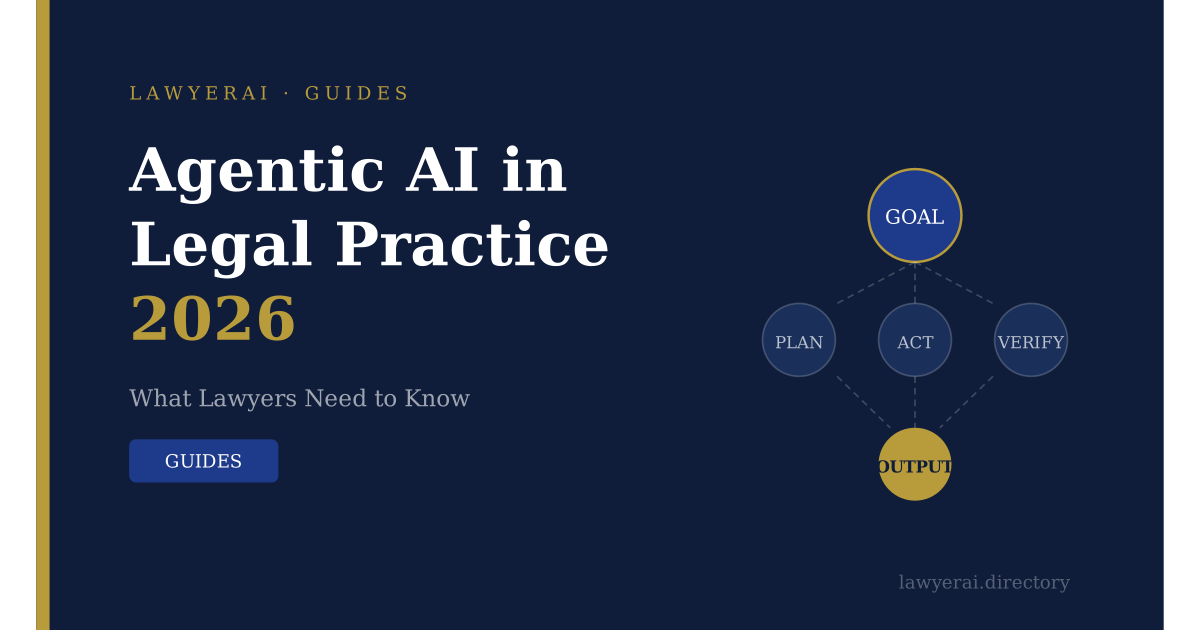
A legal AI agent is a system that can:
- Accept a high-level goal
- Break the goal into steps
- Execute those steps autonomously, including making decisions at intermediate stages
- Deliver a completed output for lawyer review
The distinction from a standard AI assistant: an assistant answers questions. An agent completes tasks.
The key phrase is "for lawyer review." No credible legal AI vendor in 2026 is positioning their agentic systems as replacing lawyer judgment. The agent handles the volume work; the lawyer handles the judgment calls.
Where Agentic AI Works in 2026
Routine contract review and redlining. This is the most mature agentic use case. Tools like Ironclad's Jurist and Harvey in agent mode can accept a counterparty NDA, review it against a configured playbook, generate a redline, and route it for approval — without human intervention at each step.
Legal hold and eDiscovery workflow. The 2026 generation adds AI judgment to custodian identification and document prioritization, compressing timelines significantly.
Client intake and matter routing. Matter intake AI tools at platforms like Clio and Lawmatics can now handle intake form processing, conflict checking, case value assessment, and attorney assignment as a connected workflow.
Legal research with cited reports. CoCounsel's Deep Research and Harvey's research agent can accept a research question, develop a multi-step research plan, query primary legal databases, and deliver a cited report.
Where Agentic AI Still Requires Heavy Oversight
Complex or unusual contracts. Agentic contract review works on standardized agreements. An NDA with unusual indemnification structures or a cross-border agreement with multi-jurisdictional governing law will challenge any current agentic system.
Strategic legal judgment. No agentic system in 2026 can tell you whether to accept a below-market limitation of liability in exchange for a key commercial relationship.
Novel legal questions. Agents perform best on tasks with well-established patterns. For questions at the frontier of the law, the research agent is a starting point, not a final answer.
Any output that goes to a court. The professional responsibility obligation to verify AI output applies at full strength to agentic systems.
The 5-Dimension View: How Agentic Features Affect Scores
When LawyerAI evaluates tools with agentic capabilities, the 5-dimension framework captures the trade-offs:
Accuracy — Agentic systems that chain multiple AI steps multiply both the capabilities and the error surfaces. We evaluate end-to-end accuracy on completed workflows, not individual steps.
Speed — This is where agentic systems win decisively. A task that required 4 hours of associate time can take 15 minutes of agent processing and 20 minutes of lawyer verification.
Usability — Agentic workflows require upfront configuration. Setting up a playbook in Ironclad or defining research parameters in Harvey takes time and legal ops resources.
Value — Agentic features typically carry a premium. Harvey's agent mode, Ironclad's Jurist, and Legora's agentic workflows are enterprise-priced.
Security — Agentic systems access more systems, make more API calls, and process more data than single-query assistants. Security evaluation must cover the full workflow.
Harvey AI — The most mature agentic legal research platform. Agent mode deploys multiple research paths in parallel, synthesizes findings, and delivers cited reports.
Ironclad — The most mature agentic contract workflow tool. Intake, review, redline, and routing agents are workflow-native, not add-ons. See our Ironclad vs. DocuSign CLM comparison.
CoCounsel — Agentic research built on Westlaw and Practical Law content. Creates a research plan, executes it across multiple databases, and delivers a structured report.
Clio — The most mature agentic intake workflow for small to mid-size firms. See our guide for solo practitioners for how this fits small firm workflows.
For in-house teams specifically, see our Solutions page for in-house counsel for a workflow-specific breakdown.
How to Evaluate Agentic AI for Your Practice: 5 Questions
1. What specific workflow do you want to automate? Define the input, the steps, and the desired output before evaluating any platform.
2. How standardized is that workflow? Agentic systems deliver the most value on high-volume, predictable workflows.
3. What is your playbook quality? Contract review agents are calibrated against your firm's standard positions.
4. What are your verification protocols? Every agentic workflow needs a defined human review checkpoint before output leaves the firm.
5. How does the vendor handle errors? Ask specifically: what happens when the agent makes a mistake?
FAQ
Q: What is the difference between an AI assistant and an agentic AI in legal practice?
An AI assistant answers questions — you ask, it responds, and you decide what to do next. An agentic AI completes tasks — you give it a goal, it determines the steps, executes them, and delivers a completed output. Agentic systems require more robust verification protocols because they make autonomous decisions you may not have reviewed.
Q: Is agentic AI safe to use for client work in 2026?
For well-defined, standardized workflows with proper verification protocols, yes. For complex, novel, or high-stakes matters, agentic AI should support lawyer judgment, not replace it.
Q: Which practice areas benefit most from agentic AI?
In-house legal departments handling high-volume commercial contracting, litigation teams managing large-scale document review, and intake-heavy practice areas see the clearest benefits.
Start with our Law Firm AI Policy glossary entry. Key elements: define which agentic workflows are approved, specify verification requirements, establish logging requirements, and designate who is responsible for reviewing agentic outputs.
Q: Will agentic AI reduce lawyer headcount?
The current evidence suggests agentic AI primarily increases capacity rather than reducing headcount. Whether that changes as the technology matures is a genuinely open question the profession is actively debating.
Scores and assessments reflect editorial analysis based on public documentation and user reports as of May 2026. LawyerAI maintains editorial independence. See our methodology for scoring details.