Section 1: The Problem No One Tells You About in the Demo
Your law librarian retired two years ago, and the partner expects a memo on a securities fraud question by 9 AM. You have Westlaw, you have Lexis, and on your monitor sits a CoCounsel tab a colleague swears by. Three platforms, three different answers, three different citations. Which one is right? Worse: which one made up the cases?
This is not a hypothetical. In 2023, two attorneys in the Mata v. Avianca case submitted a brief containing six fake citations generated by ChatGPT. The court sanctioned them. The cases did not exist. The problem has not gone away — it has gotten quieter because vendors have gotten better at making hallucinations sound authoritative. AI legal research tools are genuinely useful. But "genuinely useful" and "safe to use without checking" are not the same thing, and the gap between those two positions depends heavily on which platform you're using.
Section 2: How We Ranked Them
Most "best legal AI" lists are written by vendors or affiliates. This one isn't.
We apply four rules to every evaluation on LawyerAI:
Rule 1: LawyerAI does not accept vendor payment that influences scores. No platform paid to appear in this comparison. No platform paid to receive a higher score. If a tool appears here, it's because it's relevant to the question — not because of a commercial arrangement.
Rule 2: Every tool has real limitations — including the ones we recommend. We list specific limitations with specific numbers. If a tool has a 33% error rate in independent testing, we say 33%, not "occasional inaccuracies." If a pricing tier requires a base subscription costing $300/seat/month, we say that.
Rule 3: Pricing is published transparently. If a vendor publishes pricing, we use it. If they do not, we note "pricing not published" and use vendor-reported figures where we have them — labeled as such. We do not invent numbers or accept vendor-supplied "estimated" figures without disclosure.
Rule 4: Accuracy data from independent third parties only — vendor self-reported data labeled as such. The hallucination rates in this article come from the Stanford RegLab 2024 study, an independent academic evaluation not commissioned by any of the vendors reviewed here. Where we cite vendor self-reported claims, we say so.
Section 3: The Short Answer
If you already subscribe to Westlaw and need AI legal research, Westlaw Precision AI is the natural first step — but be aware it carries a 33% error rate in independent testing, higher than its primary competitor. If you already subscribe to LexisNexis, Lexis+ AI is the better-performing option at 17% hallucination rate in the same Stanford study. CoCounsel is the rebranded version of Casetext, now owned by Thomson Reuters — it cannot be purchased without an active Westlaw subscription, a fact not prominently disclosed in demos. Paxton AI is the best option for budget-conscious solos and small firms who don't already pay for Westlaw or Lexis. vLex Vincent is the only serious choice for international law research spanning 60+ jurisdictions. There is no single winner for everyone. There is, however, a right answer for your situation — and this guide will tell you what it is.
Section 4: Our 5-Dimension Methodology
Every tool on LawyerAI is scored across five dimensions. Scores reflect editorial assessment based on independent data, user research, and hands-on evaluation. Full methodology details are at /methodology.
- Accuracy — citation reliability, hallucination rate from independent testing, citator integration quality
- Speed — time to first useful result, task completion benchmarks, query throughput
- Usability — interface learning curve, workflow integration, support quality
- Value — cost-per-task relative to alternatives, ROI at realistic usage levels
- Security — data handling policies, confidentiality protections, relevant certifications (SOC 2, HIPAA where applicable)
Section 5: At a Glance
| Platform | Owner | Base Price (vendor-reported) | Stanford Hallucination Rate | Best For | Overall Score |
|---|
| Westlaw Precision AI | Thomson Reuters | $300–600/seat/month | 33% (independent) | Westlaw subscribers, US federal + state | 7.8 / 10 |
| Lexis+ AI | LexisNexis (RELX Group) | $150–400/seat/month | 17% (independent) | Lexis subscribers, regulatory + public law | 8.3 / 10 |
| CoCounsel | Thomson Reuters | Requires Westlaw base + add-on | 17% (independent) | Westlaw subscribers needing document workflows | 7.6 / 10 |
| Casetext | Thomson Reuters (acquired) | Standalone path closed | Not independently tested separately | Legacy users — see CoCounsel | N/A (transitioning) |
| Paxton AI | Paxton AI Inc. | $65/seat/month (published) | Not independently verified | Budget-conscious, state law, no existing subscription | 7.1 / 10 |
| vLex Vincent | vLex | $200–400/seat/month (vendor-reported) | Not independently verified | International law, EU, Latin America | 7.4 / 10 |
Westlaw Precision AI
Westlaw Precision AI is Thomson Reuters's AI layer built on top of the Westlaw database — the largest collection of US case law in existence, covering federal courts and all 50 states, plus some UK and Canadian content. For US litigators and researchers who have worked with Westlaw for years, the integration is seamless: AI-assisted research sits inside the same interface, powered by the same KeyCite citator that practitioners have trusted for decades.
What works: KeyCite remains the gold standard for citation validation in US legal research. When Westlaw Precision AI returns a case, the citator status is visible immediately — red flags for overruled authority, yellow flags for distinguishing treatment, and treatment history going back decades. The corpus breadth is unmatched for US domestic practice. Federal circuit coverage is comprehensive, state court coverage goes deeper than any competitor for most jurisdictions, and the AI surface can handle natural-language research queries that would previously have required iterative Boolean search refinement.
Westlaw's institutional trust matters too. Courts and senior partners who remain skeptical of AI generally trust Westlaw as a source — the brand carries credibility that newer entrants cannot replicate. For firms where the managing partner needs reassurance that AI research has been validated by a recognized authority, Westlaw Precision AI is the lowest-friction argument to make.
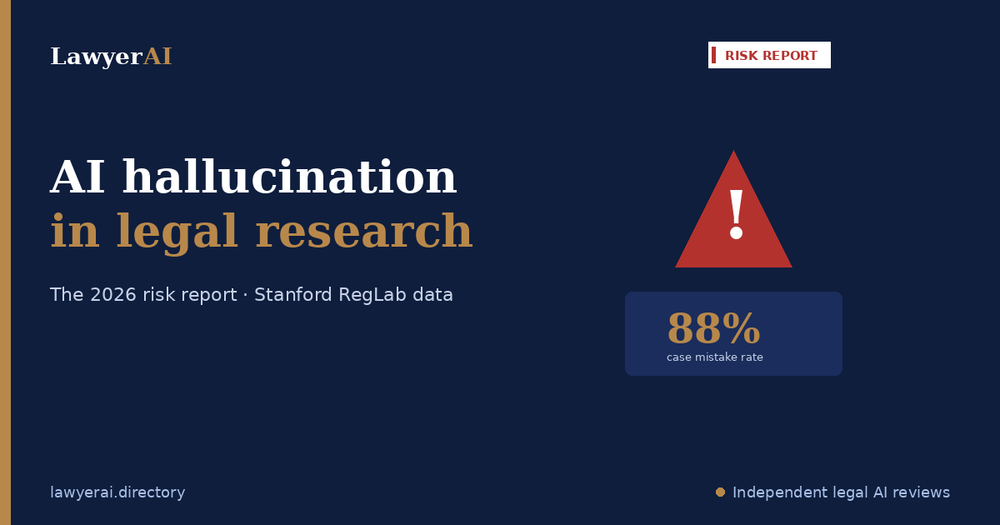
Real limitations: The Stanford RegLab 2024 independent study — not commissioned by Thomson Reuters — found that Westlaw AI-Assisted Research produced a 33% error rate in their evaluation. This is significantly higher than Lexis+ AI's 17% rate in the same study. For context, a GPT-4 baseline with no legal database access produced an 88% error rate, so Westlaw is substantially better than raw LLM output — but it is not reliable enough to use without citator verification of every result. The Stanford study should be on every practitioner's reading list before relying on this tool for court filings. See /glossary/ai-hallucination for an explanation of why even low error rates compound in multi-citation research tasks.
Pricing is not published by Thomson Reuters. Vendor-reported figures range from $300 to $600 per seat per month for full access, on top of which Westlaw base subscription costs apply. Total annual cost for a single active researcher can exceed $7,200 before AI features are factored in. The geographic scope is US, with some UK and Canadian content — this is not the right tool for practitioners who regularly handle EU, Latin American, or Asian jurisdictions.
Lexis+ AI
Lexis+ AI is LexisNexis's AI research assistant — important context: LexisNexis is a division of RELX Group, a UK-based information company, not Thomson Reuters. This distinction matters when evaluating corporate roadmaps, pricing structures, and competitive positioning. Lexis+ AI is built on the LexisNexis database and integrates with Shepard's, the LexisNexis citator that is Westlaw's KeyCite equivalent and has its own long track record in legal practice.
What works: The headline finding from the Stanford RegLab 2024 independent study is that Lexis+ AI achieved a 17% hallucination rate — the best performance among the major platforms evaluated. Compared to Westlaw AI-Assisted Research at 33%, this is a meaningful gap. For practitioners making citation-dependent arguments in federal court or advising clients on high-stakes regulatory matters, a difference of 16 percentage points in error rate is not a rounding error — it translates directly into research workflow risk.
Shepard's citator integration is deep and functional. Regulatory and public law content is a particular strength of the LexisNexis database — agencies, regulatory history, administrative law materials, and legislative history are well-indexed. The AI summarization features handle straightforward legal questions competently, producing structured output that can anchor a research memo without significant reformatting.
Real limitations: Lexis+ AI requires a LexisNexis base subscription. Pricing is not published. Vendor-reported figures range from $150 to $400 per seat per month depending on access tier — making the total cost of ownership substantial, particularly for smaller firms that do not need the full LexisNexis corpus. The geographic focus is US and UK primary; international coverage outside these jurisdictions is thinner than vLex.
AI summarization quality degrades on complex multi-issue questions. When a research query involves intersecting regulatory frameworks — say, securities disclosure obligations that interact with ERISA duties in an M&A context — the AI summaries can flatten the complexity in ways that produce misleading outputs. The 17% error rate from the Stanford study means approximately 1 in 6 AI-generated outputs contains a material error. That is better than the competition, but it is not a green light to skip verification. See /glossary/citation-validation for a practical verification workflow.
CoCounsel
CoCounsel is the product that emerged from Thomson Reuters's $650 million acquisition of Casetext in June 2023. It is being positioned as Thomson Reuters's premium AI legal assistant layer — distinct from Westlaw Precision AI in that it handles document workflows (brief analysis, deposition prep, document review) in addition to legal research. CoCounsel and Westlaw Precision AI share the same underlying Westlaw corpus. They are different tools built on the same database, with CoCounsel adding workflow capabilities beyond pure research.
What works: The document workflow capabilities are genuine. CoCounsel can ingest a brief, a set of depositions, or a contract document set and run analytical tasks against them — identifying legal issues, flagging contradictions, summarizing witness testimony. For litigation teams handling large document volumes, this is meaningfully useful. The integration with the Westlaw corpus means that when CoCounsel cites a case in a research context, it is drawing from the same database as Westlaw Precision AI. The Stanford RegLab 2024 study found CoCounsel at a 17% hallucination rate — matching Lexis+ AI and significantly better than Westlaw AI-Assisted Research in the same evaluation.
CoCounsel's user interface reflects Casetext's design heritage, which was built by lawyers-turned-technologists with a strong emphasis on practitioner experience. The workflow is cleaner than legacy Westlaw interfaces, and the brief analysis feature in particular has a track record of favorable reception from litigators who used the original Casetext product.
Real limitations: CoCounsel cannot be purchased without an active Westlaw subscription. This is the single most important fact to know before evaluating this product, and it is frequently not disclosed in demos. Westlaw base subscriptions start at approximately $3,600 per year for basic access and scale significantly from there. A practitioner evaluating CoCounsel who does not already subscribe to Westlaw is looking at a combined investment that begins at thousands of dollars per year before the CoCounsel add-on cost is applied. Attorneys who were Casetext subscribers before the acquisition and expected to continue purchasing a standalone AI research tool discovered this limitation post-acquisition — the standalone Casetext purchase path was closed.
If you are evaluating CoCounsel, you are also evaluating Westlaw. If Westlaw is not the right base database for your practice, CoCounsel is not the right AI layer. US law is the primary focus; international coverage follows Westlaw's existing limitations.
Casetext
Casetext as an independent product no longer exists in its pre-acquisition form. Thomson Reuters acquired Casetext for $650 million in June 2023. The standalone Casetext subscription path has been closed as of 2024. The brand is in active transition to CoCounsel. If you are currently evaluating "Casetext," you are evaluating CoCounsel — they are the same product under a different name at different stages of a rebranding exercise.
What worked: Casetext pioneered AI legal research in 2022 and 2023. Its CARA A.I. feature — which allowed practitioners to upload a brief and find relevant cases based on the arguments in the document — was ahead of its time and established patterns that competitors subsequently copied. The user experience was clean, the case law search was fast, and the brief analysis workflow was genuinely useful for litigators. Casetext built a reputation for taking practitioner feedback seriously and iterating quickly.
The current reality: For practitioners who subscribed to Casetext before the acquisition and valued the standalone, affordable pricing model (Casetext launched with transparent, published pricing significantly below Westlaw/Lexis levels), the post-acquisition trajectory has been frustrating. The product's future is now determined by Thomson Reuters's enterprise roadmap, not by the independent product team that built it. The Westlaw subscription requirement for CoCounsel represents a fundamental change in the business model that the original Casetext team did not create. Evaluating Casetext separately from CoCounsel is no longer a meaningful exercise. Read the CoCounsel review and the Westlaw Precision AI review instead.
Paxton AI
Paxton AI launched in 2023 with a straightforward proposition: GPT-4-powered legal research at a price point that does not require a Westlaw or Lexis subscription. At $65 per seat per month with published pricing, no minimum seat requirements, and no base subscription dependency, Paxton occupies a market position that the large incumbents have deliberately avoided — accessible legal AI for practitioners who cannot or will not pay enterprise rates.
What works: The pricing transparency is itself notable in a market where most vendors refuse to publish numbers. $65 per seat per month with no minimums is a genuinely accessible entry point for solo practitioners, small firm associates, and public defenders who need AI legal research capability but whose economics make Westlaw/Lexis pricing prohibitive. Onboarding is fast — practitioners report being productive within hours rather than the days or weeks required for enterprise legal database implementations. The state law research capability is a particular strength: Paxton has invested in state-level legal content, making it useful for practitioners whose practice is heavily state-court-focused rather than federal.
No base subscription means no lock-in to a legacy database relationship. For a practitioner starting a new firm or reassessing their research budget, Paxton represents a genuinely independent option that does not require first committing to a $3,600+ annual database subscription before accessing AI features.
Real limitations: Paxton's corpus is smaller than Westlaw and LexisNexis. This is the unavoidable consequence of its independent status — building and maintaining a comprehensive legal database at the scale of Thomson Reuters or RELX Group requires capital and institutional infrastructure that a 2023-vintage startup does not have. US primary jurisdiction, limited international law coverage. Paxton is not the right tool for federal appellate practice requiring exhaustive circuit court analysis or for any matter with international law dimensions.
The hallucination rate has not been independently verified as of April 2026. The Stanford RegLab study evaluated Westlaw and Lexis products; Paxton was not included. This is not a criticism of Paxton specifically — many newer tools have not been subjected to independent academic evaluation — but it means practitioners should apply additional verification discipline when using Paxton for high-stakes research tasks. The 2023 launch date means the product has limited track record in complex federal practice compared to platforms with 20+ years of legal database history.
vLex Vincent
vLex Vincent is the AI legal research interface for vLex, the international legal database covering 60+ jurisdictions. For practitioners whose work extends beyond US and UK law — EU regulations, Latin American civil law systems, international arbitration precedents, cross-border M&A with multiple governing law clauses — vLex Vincent is the only platform in this comparison that takes international research seriously.
What works: The breadth of jurisdiction coverage is unmatched. EU primary law, secondary legislation, case law from Member State courts, Latin American legal systems, Asian jurisdictions — vLex has invested for years in building a genuinely global legal database. For international practitioners comparing this to Westlaw or Lexis, the difference is not marginal. Westlaw's international coverage is primarily US-focused with UK and Canadian additions; vLex's is the reverse, with strong non-Anglophone coverage that Westlaw and Lexis simply do not attempt. The AI-powered semantic search understands legal concepts across jurisdictions in a way that keyword-based international research cannot replicate. For EU law work in particular — Directives, Regulations, CJEU decisions — the research quality is substantially better than what US-centric platforms offer.
Real limitations: Pricing is not published. Vendor-reported figures range from $200 to $400 per seat per month. For a US practitioner whose international work is occasional rather than routine, this represents a significant cost for capability that supplements rather than replaces a domestic research tool. US case law coverage is thinner than Westlaw or Lexis — a practitioner using vLex as their primary US research tool will feel the gaps in state court coverage. The citator functionality for US law is less robust than KeyCite or Shepard's; US-focused practitioners who rely on citator signals for quick validity checks will find vLex's US citation treatment less comprehensive.
Interface familiarity is a real adoption barrier for US practitioners. The vLex interface was not designed with US BigLaw workflows as the primary use case, and practitioners accustomed to Westlaw's research trail or Lexis's folder organization will face a learning curve. For truly international practices, this is worth overcoming. For US-primary practices with occasional international questions, the calculus is less clear.
Section 7: Which One Is Right for You?
Use this decision framework to identify your starting point. From there, consult the individual tool reviews for full detail.
Branch 1: You already subscribe to Westlaw.
Start with Westlaw Precision AI. You are already paying for the corpus; adding the AI layer is incremental. If you also handle large document review or brief analysis workflows, evaluate CoCounsel — it adds workflow features at an additional cost, but the Westlaw subscription requirement is already satisfied. Note the 33% error rate from the Stanford study: build verification into your workflow.
Branch 2: You already subscribe to LexisNexis.
Use Lexis+ AI. It achieves the best hallucination rate in independent testing (17%), and it is built on the database you already pay for. Switching to Westlaw to access CoCounsel or Westlaw Precision AI means paying for a new base subscription and losing Shepard's for a citator you know. The math rarely works unless your practice has specific reasons to prefer Westlaw's corpus.
Branch 3: You have no existing database subscription and are cost-conscious.
Evaluate Paxton AI first. At $65/seat/month with published pricing and no minimums, it is the lowest-friction entry point for AI legal research without a legacy database commitment. Understand the corpus limitations — if your work is heavily federal appellate or requires comprehensive state court coverage, you may eventually need to add Westlaw or Lexis. But for state-law-focused practice, solo practitioners, and public sector attorneys with constrained budgets, Paxton is a serious option that the major vendors would prefer you not consider.
Branch 4: Your practice involves international law — EU, Latin America, or multi-jurisdiction matters.
vLex Vincent is not optional — it is the only platform in this comparison with meaningful multi-jurisdiction coverage. If you also need strong US coverage, you may need to maintain both vLex and a US database subscription. See the compare/westlaw-vs-lexis-ai page for guidance on the US side of that combination.
Branch 5: You need the best available hallucination performance and are choosing between platforms without an existing subscription.
Lexis+ AI and CoCounsel both achieved 17% in the Stanford RegLab study. Lexis+ AI does not require a secondary product dependency; CoCounsel requires Westlaw. If you are choosing fresh and accuracy is the primary criterion, Lexis+ AI gives you the best independently-documented performance with a single subscription relationship.
For big law firm solutions and litigation department guidance, see the dedicated pages on LawyerAI.
Section 8: FAQ
1. What happened to Casetext — can I still buy it?
No. Thomson Reuters acquired Casetext for $650 million in June 2023. The standalone Casetext subscription path closed in 2024 as the brand transitioned to CoCounsel. If you were a Casetext subscriber hoping to renew an independent subscription, that path no longer exists. The product now requires an active Westlaw subscription — a significant change from Casetext's original, database-independent model. Current Casetext users are being migrated to CoCounsel. Evaluate CoCounsel as the continuation of the Casetext product line, with the Westlaw subscription requirement as a mandatory condition.
2. Which AI legal research tool has the lowest hallucination rate?
Based on the Stanford RegLab 2024 independent study — the most rigorous publicly available evaluation as of April 2026 — both Lexis+ AI and CoCounsel achieved 17% hallucination rates, compared to Westlaw AI-Assisted Research at 33%. A GPT-4 baseline with no legal database access produced an 88% error rate, confirming that database-grounded legal AI performs substantially better than raw LLM output. See /glossary/ai-hallucination for the technical explanation of why hallucinations occur even in database-grounded systems. Note that Paxton AI and vLex were not evaluated in the Stanford study.
3. Do I need both Westlaw and Lexis, or will one AI tool cover both?
For most US domestic practices, one comprehensive database is sufficient. The databases overlap significantly on core federal case law; the differences emerge in secondary content, regulatory materials, and specific state court depth. No AI tool currently provides unified AI-powered research across both the Westlaw and LexisNexis corpora — you access one or the other. The exception is practices that genuinely need both databases' secondary sources, treatises, or specialty content. If you are choosing between databases rather than combining them, use the compare/westlaw-vs-lexis-ai comparison for a detailed head-to-head.
4. How do I verify a citation generated by AI legal research?
Run every AI-generated citation through the relevant citator — KeyCite for Westlaw, Shepard's for Lexis — before including it in any filing or client advice. Citator verification catches two failure modes: AI hallucination (cases that do not exist or were never decided the way the AI described) and citation validity problems (cases that were subsequently overruled or limited). Retrieve the full text of any case you plan to cite; do not rely on the AI summary alone. For court filings, treat AI research output as a starting point for human verification, not a finished product. See /glossary/citation-validation for a step-by-step verification workflow.
5. Are AI legal research tools accurate enough for federal court filings?
They are accurate enough to use as research starting points — they are not accurate enough to use without verification. The 17% error rate from the Stanford study (the best performance in the evaluation) means that approximately one in six AI outputs contains a material error. Across a brief with 20 citations, the probability of at least one AI-generated error in your research is statistically high. The Mata v. Avianca sanctions in 2023 made clear that federal judges will not accept "the AI said so" as an explanation for a fabricated citation. AI legal research tools should accelerate human research, not replace the human verification step. For more on AI liability in litigation contexts, see the LawyerAI solutions page.
Editorial Independence
LawyerAI evaluations are independent. We do not accept payment that influences our editorial scores. Featured placements (when introduced) will be clearly labeled and will not affect our 5-dimension scoring methodology. Our rankings reflect product reality at time of writing — we re-review every quarter and update lastReviewedAt accordingly.
If you spot an error, email editorial@lawyerai.directory. We correct in public and credit the reporter.