Contract review is where legal AI delivers its clearest ROI. A task that once consumed 3–6 hours of associate time per agreement now takes minutes with the right tool. But the market is crowded, and most "best of" lists are written by vendors reviewing their own software.
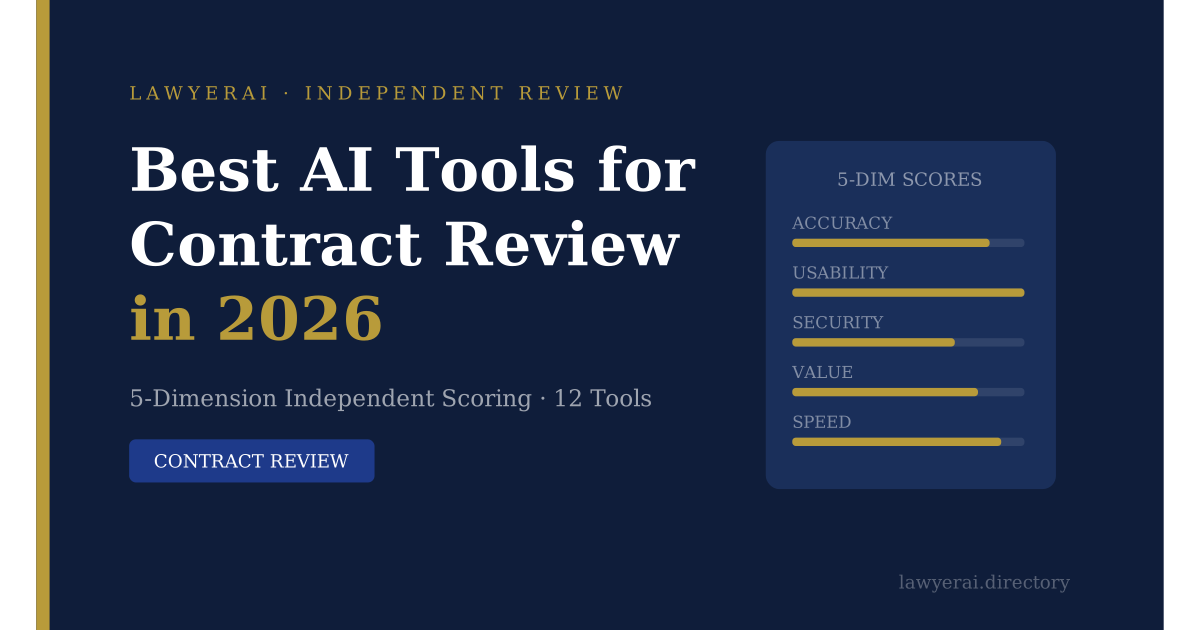
This guide applies LawyerAI's 5-dimension methodology — Accuracy, Speed, Usability, Value, and Security — to 12 contract review tools available in 2026. No vendor paid for placement. No affiliate links. Every score reflects editorial assessment based on public documentation, user reports, and platform testing.
The short answer: For most law firms, Spellbook leads on Usability and Value. For enterprise in-house teams, Luminance and ContractPodAi lead on Accuracy and Security. For eDiscovery-adjacent contract work, Kira remains the most mature option.
Why Contract Review Is the Highest-ROI AI Use Case
Contract review combines three conditions that make AI particularly effective:
High volume. Most legal teams handle dozens to hundreds of contracts monthly. NDA review, vendor agreements, employment terms — the volume is predictable and large.
Pattern recognition. Most contract review involves identifying whether specific clauses are present, whether they deviate from standard positions, and whether specific risks exist. These are tasks AI handles well.
Clear verification path. Unlike legal research, where a hallucinated citation can slip through, contract review outputs are directly verifiable against the source document. A lawyer can confirm an AI-flagged clause in seconds.
The result is measurable time savings — typically 60–80% reduction in first-pass review time for standardized agreements — with manageable verification overhead.
The 5-Dimension Framework Applied to Contract Review
LawyerAI scores every tool on five dimensions. For contract review specifically, here's what each dimension measures:
Accuracy — Does the tool correctly identify clause types, flag genuine deviations, and avoid false positives? In contract review, a false negative (missing a problematic clause) is worse than a false positive (flagging a standard clause). We weight recall over precision.
Speed — How quickly does the tool process a typical NDA (5–10 pages) and a typical MSA (30–50 pages)? Processing time matters in high-volume environments.
Usability — Does the tool fit into existing workflows? Tools that work inside Microsoft Word (Spellbook) or inside existing CLM platforms score higher than standalone tools requiring document uploads.
Value — What is the price-to-output ratio? We factor in starting price, free trial availability, and per-seat vs. usage-based pricing.
Security — Does the tool hold SOC 2 Type II? Is there an explicit commitment that client documents are not used to train models? Does the vendor offer a Data Processing Agreement?
Spellbook
Overall: 4.1 / 5
| Dimension | Score |
|---|
| Accuracy | 4.0 |
| Speed | 4.5 |
| Usability | 5.0 |
| Value | 4.0 |
| Security | 3.5 |
Spellbook earns its dominant market position through workflow integration. It operates inside Microsoft Word — where most transactional lawyers already work — and delivers AI-assisted drafting, clause flagging, and redline suggestions without requiring any platform migration.
The Playbooks feature allows firms to codify their standard positions. Once configured, Spellbook flags deviations from those positions automatically.
Best for: Transactional lawyers at small to mid-size firms who draft and review contracts in Word daily.
See our full Spellbook vs. Luminance comparison for a head-to-head analysis.
Luminance
Overall: 4.2 / 5
| Dimension | Score |
|---|
| Accuracy | 4.5 |
| Speed | 4.0 |
| Usability | 3.5 |
| Value | 3.5 |
| Security | 5.0 |
Luminance's Legal-Grade AI architecture is purpose-built for enterprise contract review at scale. Its Institutional Memory feature — which retains the reasoning behind past negotiation decisions — is genuinely differentiated. The platform can analyze 10,000+ documents in minutes, making it the tool of choice for M&A due diligence at large firms.
Security credentials are the strongest in the category: ISO 27001, SOC 2 Type II, and GDPR compliance are all documented.
Best for: Am Law 200 firms and large in-house legal departments running high-volume M&A and commercial contract portfolios.
Kira (Litera)
Overall: 3.8 / 5
| Dimension | Score |
|---|
| Accuracy | 4.5 |
| Speed | 3.5 |
| Usability | 3.5 |
| Value | 3.0 |
| Security | 4.5 |
Kira was one of the first purpose-built AI contract extraction tools, and its 1,400+ smart fields for clause and data extraction remain an asset. The recent addition of the Lito AI agent adds conversational analysis on top of the extraction foundation.
Best for: Large law firms running M&A, real estate, and corporate finance due diligence workflows.
Draftable
Overall: 4.0 / 5
| Dimension | Score |
|---|
| Accuracy | 4.5 |
| Speed | 4.5 |
| Usability | 4.5 |
| Value | 4.0 |
| Security | 4.0 |
Draftable is an AI-powered document comparison tool. For the specific task of redlining and version comparison, it is the fastest and most accurate option in its category. Its free tier makes it accessible to solo practitioners.
Best for: Any lawyer who regularly compares contract versions — as a complement to a primary contract review tool.
ContractPodAi
Overall: 3.9 / 5
| Dimension | Score |
|---|
| Accuracy | 4.0 |
| Speed | 4.0 |
| Usability | 3.5 |
| Value | 3.5 |
| Security | 4.5 |
ContractPodAi's Leah AI assistant goes beyond metadata extraction to answer natural-language questions about contract portfolios. The platform's strength is contract lifecycle management breadth, covering creation through obligation tracking.
Best for: Enterprise legal departments with 1,000+ contracts needing systematic extraction, analysis, and ongoing obligation management.
How to Choose: A Decision Framework
Contract review AI selection comes down to three questions:
1. What is your primary use case?
- High-volume first-pass review of standardized agreements → Spellbook or Robin AI
- M&A due diligence on large document sets → Luminance or Kira
- Post-signature obligation tracking → ContractPodAi or Ironclad
- Version comparison and redline tracking → Draftable
2. What is your firm size and budget?
3. What are your security requirements?
- Standard commercial work → SOC 2 Type II is sufficient baseline
- Cross-border transactions / EU clients → Require GDPR compliance
- Regulated industries → Require ISO 27001
For side-by-side comparisons, see Spellbook vs. Luminance and Ironclad vs. DocuSign CLM.
What to Watch in 2026: Agentic Contract Review
The most significant development in 2026 is the emergence of agentic AI — systems that complete multi-step contract tasks with minimal human intervention. Ironclad's Jurist, Harvey in agent mode, and ContractPodAi's Leah can now handle intake → review → redline → route-for-approval workflows autonomously for routine agreement types.
The caveat: agentic capabilities are currently reliable only for standardized agreement types. AI output verification protocols remain essential regardless of the tool's automation level.
FAQ
Q: Can AI replace lawyers for contract review?
No. AI handles first-pass analysis faster and more consistently than manual review. But legal judgment on materiality, negotiation strategy, and client-specific risk tolerance requires a lawyer. AI compresses the time lawyers spend on mechanical review, freeing them for higher-value analysis.
Accuracy varies significantly by tool and contract type. On standardized agreements, leading tools achieve 85–95% precision on clause identification. On complex or unusual agreements, accuracy drops. Always verify AI outputs against source documents.
Q: What security should I require from a contract review AI vendor?
At minimum: SOC 2 Type II certification, an explicit commitment that your documents are not used to train AI models, and a signed Data Processing Agreement. See our security evaluation guide for full details.
Draftable offers a free tier for document comparison. Spellbook offers a free trial. General-purpose AI tools lack the legal-specific training and security architecture of purpose-built contract review platforms.
Spellbook and Draftable can be live in hours. Enterprise CLM platforms typically require 3–6 months of implementation and configuration.
Scores reflect editorial assessment based on public documentation and user reports as of May 2026. LawyerAI maintains editorial independence — Featured placement does not affect scores. See our Editorial Independence policy.