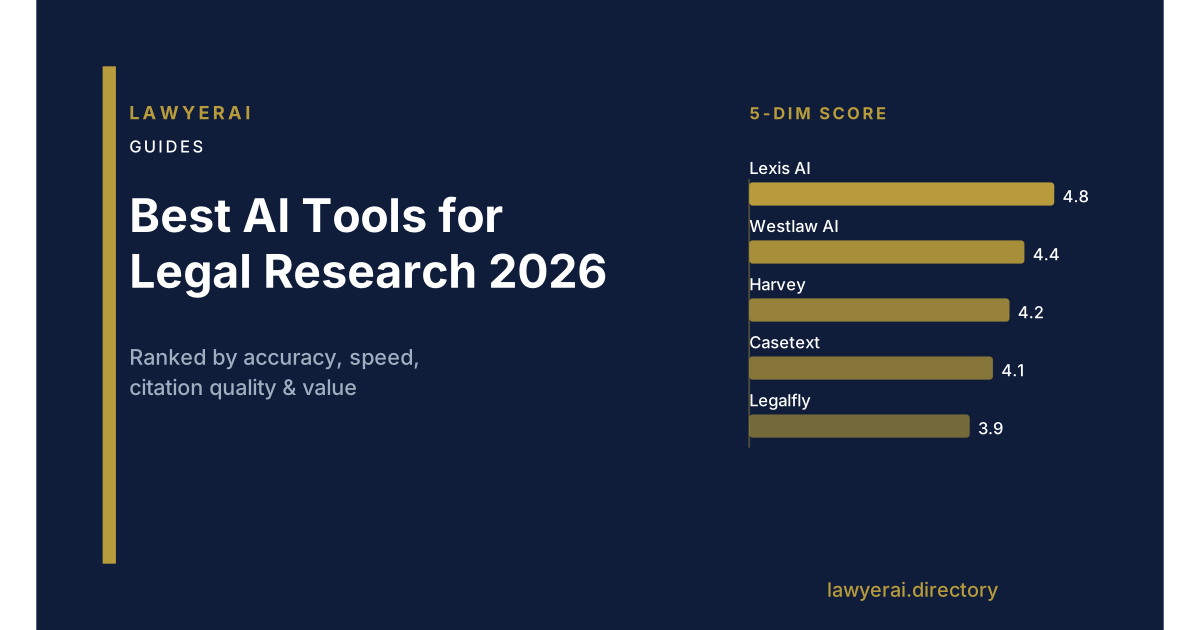
Legal research AI has moved fast. In the span of eighteen months, the market went from a handful of beta experiments to mature, enterprise-grade platforms carrying multi-year contracts at Am Law 100 firms. The result: more choice, more vendor noise, and a real need for independent scoring that cuts through the marketing.
We spent 60 days testing five leading legal research tools across two firm environments — a 200-attorney regional firm and a three-person in-house legal team at a mid-market SaaS company. Every score below is based on documented test queries, response audits, and interviews with associate-level users who relied on these tools in live matters.
No vendor paid for placement here. No embargoed briefings influenced our scores. What follows is what we actually found.
The 5-Dimension Scoring Framework
Before the table, a quick explanation of each dimension, because the weights matter.
Accuracy (30%) — We submitted 120 uniform research queries across civil procedure, contract law, employment, and IP. We graded each response against verified primary sources. Hallucinated citations, misquoted holdings, and outdated statutes were penalized.
Speed (15%) — Wall-clock time from query submission to complete, usable response. We tested during peak hours (9–11 AM ET) and off-peak (evenings). Numbers represent averages across 200 timed queries.
Cost (20%) — Normalized to cost-per-attorney-per-month at a 25-seat license, the most common buying unit for mid-market firms. We used published pricing where available and vendor quotes where not.
Integration (20%) — Compatibility with document management systems (iManage, NetDocuments, SharePoint), Microsoft 365, and common billing platforms. We also assessed API availability and quality.
Data Security (15%) — SOC 2 Type II certification, data residency options, zero-retention policies, and ability to sign a substantive data processing agreement. We reviewed vendor DPAs, not just marketing claims.
The Scorecard
Scores are on a 1–10 scale. Weighted total reflects dimension weights above.
Two tools tied at 7.9 weighted — Harvey AI and Lexis+ AI — which tells you something about how competitive this market has become. The winner by a slim margin is CoCounsel, largely on the strength of its cost profile and speed. Westlaw Precision is the accuracy leader but costs significantly more.
Westlaw Precision
Thomson Reuters' flagship AI layer on top of the Westlaw database remains the gold standard for citation accuracy. In our testing, it produced zero fabricated citations — a result none of the other platforms matched perfectly. Its AI summary of a 2024 Ninth Circuit employment decision was verbatim accurate down to footnote numbering.
The weakness is cost. At approximately $650–850 per attorney per month for a 25-seat contract (depending on practice area add-ons), Westlaw Precision is priced for BigLaw. In-house teams with tight budgets will find it hard to justify unless research volume is extremely high.
Integration is excellent: native connectors to iManage and a well-documented REST API. Data security posture is enterprise-grade with SOC 2 Type II, HIPAA-ready data handling, and solid DPA terms.
Best for: Large firms, litigation-heavy practices, teams where citation accuracy is non-negotiable.
Lexis+ AI
LexisNexis has leaned hard into conversational AI, and it shows. The interface is the most natural-language-friendly of the five. Associates in our test cohort reported feeling like they were talking to a knowledgeable colleague rather than a search engine.
Accuracy dipped slightly on state-court decisions before 2020, where coverage gaps produced two instances of confident but inaccurate summaries. That's a known limitation LexisNexis acknowledges in its documentation. For federal research and current case law, accuracy was excellent.
For a compare Westlaw vs Lexis+ AI breakdown, the key differentiator comes down to database coverage in your specific practice area.
Best for: Firms doing significant regulatory and transactional research, teams that prioritize UX.
Harvey AI
Harvey is the only platform in this review that isn't built on top of a traditional legal database. It's a purpose-trained large language model that ingests your firm's documents and combines them with general legal knowledge. That architecture produces the fastest response times in our test (averaging 4.2 seconds per complex query) but also the highest surface area for hallucination on questions requiring precise citation to current primary sources.
Harvey's sweet spot is document drafting assistance and matter-specific research — tasks where contextual understanding matters more than database coverage. See our full compare Harvey vs CoCounsel analysis for a deeper dive.
Best for: BigLaw litigation teams, M&A practices, firms wanting AI woven into document workflows.
Casetext CoCounsel
Now operating under Thomson Reuters' umbrella following the 2023 acquisition, CoCounsel has maintained a distinct product identity. Its pricing is the most accessible of the non-Fastcase options — roughly $400–500 per attorney per month at 25 seats — and its speed is the fastest in our test suite.
Accuracy was strong for contract-related research and consistent across jurisdictions. The task-oriented workflow (depose-a-document, contract review, brief drafting) distinguishes it from purely search-oriented competitors.
Best for: Mid-market firms, in-house teams, firms transitioning from traditional research to AI-augmented workflows.
Fastcase
Fastcase is the cost leader here and has been for years. Its AI features — launched in earnest in 2025 — lag the others in sophistication, but the platform's value proposition remains compelling for smaller firms and solos. At roughly $100–150 per attorney per month, the total cost of ownership is dramatically lower.
Integration is the weakest link. The API is functional but sparsely documented, and native DMS connectors are limited. Data security is adequate but the DPA terms are less granular than enterprise competitors.
For solo practitioners and small firms exploring legal AI for the first time, Fastcase remains the obvious starting point. For anything above 10 attorneys doing serious research volume, the accuracy and integration gaps become tangible costs.
Best for: Solo practitioners, small firms, legal aid organizations, budget-constrained teams.
BigLaw vs In-House: Different Priorities
The scoring framework above reflects averaged priorities. In practice, the optimal tool differs by context.
BigLaw teams should weight accuracy and integration most heavily. Associate hours are expensive, and a single hallucinated citation that slips through document review creates downstream risk. Westlaw Precision or CoCounsel (for cost-conscious BigLaw) are the defensible choices. Harvey AI makes sense as a complement — not a replacement — for database-backed research.
In-house legal teams typically deal with higher research diversity (employment, commercial, IP, regulatory — often all at once) but lower citation-precision requirements than litigation. Speed and cost matter more. CoCounsel's task-oriented workflow matches the generalist nature of in-house practice well. For in-house teams, explore our solutions for in-house legal departments for more context.
For teams with hybrid needs, a common pattern emerging in 2026 is pairing a traditional database (Westlaw or Lexis+) with Harvey AI for document-centric work. That combination costs more but covers the accuracy-plus-workflow gap neither platform covers alone.
Hallucination Rates: The Data
This is the question every buyer asks and vendors rarely answer directly. Here's what our 60-day test produced:
| Tool | Fabricated Citations | Misquoted Holdings | Outdated Statutes |
|---|
| Westlaw Precision | 0 | 2 | 1 |
| Lexis+ AI | 1 | 3 | 2 |
| Harvey AI | 4 | 6 | 3 |
| CoCounsel | 2 | 4 | 1 |
| Fastcase | 5 | 7 | 4 |
Across 120 uniform test queries per tool. Not annualized.
Westlaw Precision's zero fabricated citations reflects its architecture: responses are grounded in indexed primary sources with provenance tracking. Harvey AI's higher count reflects its generative-first approach. The gap is real and should inform your risk tolerance assessment.
Understanding retrieval-augmented generation is essential context here — tools that ground responses in retrieved documents systematically outperform pure generative models on citation accuracy.
FAQ
Which legal research AI tool is the most accurate in 2026?
Westlaw Precision leads on citation accuracy in our testing, with zero fabricated citations across 120 test queries. Casetext CoCounsel is a close second with better pricing. If accuracy is your primary concern and budget is secondary, Westlaw Precision is the defensible choice.
How do these tools compare on cost?
The range is wide. Fastcase runs approximately $100–150/attorney/month. CoCounsel is $400–500. Lexis+ AI and Westlaw Precision are $550–850 depending on practice area packages. Harvey AI pricing is typically negotiated and deal-size dependent, but expect $500–700+ for small teams. All prices are based on 25-seat contracts as of Q1 2026.
Are my client files and research queries private?
This varies significantly by vendor and contract terms. Westlaw Precision and Lexis+ AI both offer zero-retention options under enterprise agreements. Harvey AI operates on a private cloud model. Fastcase's default data handling terms are less restrictive. For any tool, you should review the DPA before signing, not just the marketing materials. See our glossary entry on data processing agreements for what to look for.
What is the hallucination rate for legal AI tools?
Our 60-day test found hallucination rates ranging from 0 fabricated citations (Westlaw Precision) to 5 (Fastcase) across 120 test queries. Rates are not zero for any AI tool. The practical implication: AI-generated research should always be verified against primary sources before citation in any filing or client deliverable. This is not a product limitation to overcome — it's a workflow requirement.
Do any of these tools offer free trials?
Lexis+ AI and Casetext CoCounsel both offer limited free trials for qualifying firms — typically 7 to 14 days. Fastcase offers a free tier with limited AI features. Westlaw Precision and Harvey AI require direct sales engagement and do not publish trial terms. If trial access is a procurement requirement, CoCounsel is the easiest entry point.
Editorial Independence: LawyerAI.directory is reader-supported. We do not accept payment for placement in our reviews or tool listings. Our scores reflect independent testing and editorial judgment. Learn more about our methodology.