The EU AI Act is no longer a future compliance problem. With the general-purpose AI provisions taking effect in August 2026, law firms that have deployed AI tools — for legal research, contract analysis, document drafting, or client intake — are operating under a regulatory framework that imposes concrete obligations on both deployers and providers of covered AI systems.
This guide is written for law firm general counsels, managing partners, and practice technology directors who need to understand what the Act actually requires, which AI systems fall under its scope, and what specific steps must be taken before August 2026. It is not a guide to the Act as an area of legal practice — it is a compliance guide for firms as regulated entities.
Given the pace of regulatory guidance from the European AI Office, some details below will evolve. This post reflects the state of official guidance and Commission interpretations as of March 2026. We recommend treating it as a baseline, not a finished compliance program.
Which AI Systems Are Covered — And Does This Apply to Your Firm?
The threshold question for most firms: does the EU AI Act apply to us?
The Act has extraterritorial reach comparable to the GDPR. If your firm's AI system outputs are used within the EU — or if you deploy AI tools that affect EU data subjects — the Act can apply regardless of where your firm is headquartered. A New York-based firm with EU clients, an office in Frankfurt, or matters involving EU-based counterparties is likely within scope for at least some provisions.
Three categories of firms and their exposure:
-
Firms with EU offices or EU-based personnel — Full scope of the Act applies to AI systems deployed in those jurisdictions. This includes research AI, drafting assistants, and any client-facing AI tools.
-
Firms outside the EU with EU-based clients — The Act applies where the AI system's output is used within the EU. If your AI-generated contract analysis or due diligence report is delivered to an EU client, EU regulators take the position that the deployer obligations follow the output.
-
Firms with no EU connection — Narrower exposure. GPAI (general-purpose AI) model provider obligations may still apply if the underlying model is offered or made available in the EU by its developer, but the deployer-level obligations are unlikely to apply directly.
The practical implication: most firms with meaningful international practice should assume the Act applies to at least some of their AI deployments.
The EU AI Act compliance glossary provides plain-English definitions of "deployer," "provider," "placing on the market," and other terms of art that matter for scope analysis.
High-Risk Classification: Does Legal AI Qualify?
The Act establishes four risk tiers. The highest-risk tier — with the heaviest obligations — covers systems used in specific regulated domains. The question for law firms: does legal AI fall into the high-risk category?
The direct answer: most legal AI tools are not classified as high-risk under Annex III in their current form. Legal research tools, contract drafting assistants, and document review platforms generally do not fall within the enumerated high-risk categories, which focus on:
- Biometric identification
- Critical infrastructure management
- Education and vocational training
- Employment and worker management
- Access to essential private services (credit scoring, insurance)
- Law enforcement and border management
- Administration of justice
That last category — "administration of justice" — is where the legal AI question gets complicated. The Act specifically flags AI systems used to assist judicial authorities in researching and interpreting facts and law as high-risk. Whether this covers law firm AI tools is contested. The Commission's position, as of early 2026, is that the high-risk classification in administration of justice applies to AI used by courts and public legal authorities — not private practitioners. However, AI tools used in court-connected processes (automated document production for filings, AI-assisted brief drafting for submission to courts) may attract scrutiny.
AI systems that do trigger high-risk classification for law firm purposes:
- AI used in employment decisions (e.g., AI-assisted hiring tools used within the firm's HR function)
- Credit or risk assessment tools used in client matters
- AI embedded in any public-facing client intake that makes or influences eligibility decisions
For these systems, the obligations are substantially heavier. See the compliance timeline below.
Required Documentation for Covered AI Systems
Even for AI systems that fall outside the high-risk category, the GPAI rules — which take effect in August 2026 — impose documentation obligations on providers of general-purpose AI models with systemic risk. This matters for law firms primarily through the obligations it places on your AI vendors, and secondarily through the deployer-level transparency obligations it creates for the firm itself.
What deployers (law firms) must do under the GPAI rules:
- Maintain records of which AI systems are deployed, their intended purpose, and the vendor's compliance documentation
- Implement appropriate human oversight measures for AI outputs used in client-facing work
- Ensure that information provided to the AI vendor about your use of the system is accurate and not misleading as to the system's intended purpose
- Not use a general-purpose AI system for a purpose that the provider has explicitly flagged as out of scope
Vendor documentation you should obtain and retain:
For each AI tool deployed in client matters, request and retain:
- The vendor's EU AI Act compliance statement or conformity assessment (if applicable)
- A summary of the model's training data sources and known limitations
- The vendor's data processing agreement with provisions addressing EU AI Act obligations
- Documentation of the vendor's human oversight and feedback mechanisms
- Incident response procedures for AI errors in client matters
This documentation exercise serves a dual purpose: it satisfies your internal compliance obligations and surfaces vendor risk. Vendors that cannot or will not provide meaningful documentation are vendors whose compliance posture you cannot assess.
Vendor Due Diligence Checklist
The Act shifts meaningful obligations upstream to AI providers, but deployers cannot simply rely on vendor representations. Here is the due diligence checklist we recommend for law firms evaluating or renewing AI vendor contracts in 2026:
Technical compliance:
Data and privacy:
Operational:
Tools like Harvey AI and Lexis+ AI have both published EU AI Act readiness statements — review these against the checklist above rather than accepting them at face value.
Staff Training Requirements
The Act requires deployers to ensure that persons working with AI systems have sufficient AI literacy to use those systems appropriately. This is not a one-time training requirement — it is an ongoing obligation tied to the lifecycle of each AI deployment.
Minimum training program elements for law firms:
-
AI literacy baseline — All staff using AI tools should understand what the tool does, what it does not do, and the difference between AI output and verified legal research. This is particularly important for junior associates who may treat AI output with unwarranted deference.
-
Tool-specific training — Each platform has specific limitations, known failure modes, and appropriate use boundaries. Onboarding training should cover these explicitly, not just the feature set.
-
Oversight procedures — Staff must understand when AI outputs require human verification before use in client deliverables. The practical standard: anything that will be cited to a court or delivered to a client as legal advice requires attorney review of the underlying sources.
-
Incident reporting — Firms should establish a clear escalation path for reporting AI errors, hallucinations, or unexpected outputs. This supports both internal quality control and vendor accountability.
-
Annual refresh — Given the pace of change in both AI capabilities and regulatory guidance, annual training refreshes are the minimum. Ideally, training is updated whenever a new tool is deployed or a significant version update changes a tool's behavior.
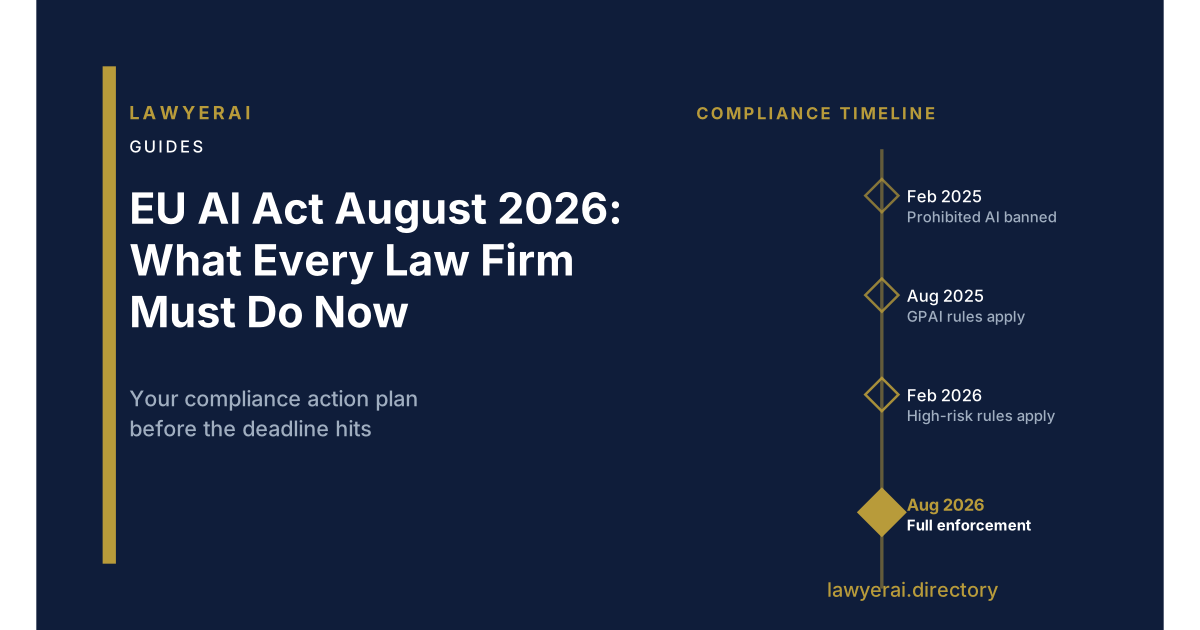
Compliance Timeline
| Deadline | Obligation | Who It Applies To |
|---|
| February 2025 | Prohibited AI practices ban in effect | All firms operating in EU |
| August 2025 | GPAI code of practice finalized | AI providers (informs deployer standards) |
| August 2026 | GPAI transparency and copyright obligations in effect | AI providers; deployers must verify vendor compliance |
| August 2026 | High-risk AI system requirements fully in effect | Deployers of high-risk AI (including HR AI, risk assessment AI) |
| August 2027 | Remaining Annex I high-risk systems obligations | Narrower set of regulated product AI systems |
What must be done before August 2026:
- Complete AI system inventory across all practice areas and administrative functions
- Classify each system by risk tier
- Obtain and review vendor compliance documentation for all systems
- Update vendor contracts to reflect EU AI Act deployer/provider allocation of responsibilities
- Implement staff AI literacy training program
- Establish AI incident reporting procedure
- Document human oversight mechanisms for all client-facing AI outputs
For firms tracking compliance across multiple regulatory frameworks simultaneously, the intersection of EU AI Act obligations with GDPR, the UK Data Protection Act, and US state AI laws (Colorado, Texas, and Illinois have the most developed frameworks) creates a complex matrix. See our solutions for legal compliance teams for resources on managing multi-jurisdictional AI governance.
Penalties
Non-compliance carries penalties calibrated to the risk tier of the violation:
- Prohibited AI practices violations: Up to €35 million or 7% of global annual turnover, whichever is higher
- High-risk AI system violations: Up to €15 million or 3% of global annual turnover
- Provision of incorrect or misleading information to authorities: Up to €7.5 million or 1% of global annual turnover
For law firms, the most relevant penalty tier is the high-risk category — applicable to firms using AI in employment decisions, credit or risk assessment functions, or any AI system that later gets reclassified as high-risk through Commission implementing acts. The 3% global turnover figure is material for large firms.
Enforcement will be conducted by national AI supervisory authorities in each EU member state, coordinated by the European AI Office for GPAI models. UK firms post-Brexit are subject to separate UK-specific AI governance frameworks, though the UK's approach has been more principles-based and less prescriptive than the EU Act.
FAQ
Does the EU AI Act apply to US law firms?
Yes, if the firm has EU offices, EU-based personnel, or delivers AI-assisted work product to EU clients. The Act follows the GDPR model of extraterritorial reach based on where outputs are used and who is affected. A US-only firm with no EU connection has narrow exposure, but most Am Law 200 firms should assume some provisions apply.
What counts as high-risk AI for law firms under the Act?
For law firms specifically, the most clearly applicable high-risk categories are AI used in employment decisions (within the firm's HR function) and AI that assists in administration of justice functions. Most legal research, drafting, and document review AI falls outside current high-risk classification, though this may evolve through Commission implementing acts. The administration of justice carve-out for private practitioners is not permanently settled.
What are the penalties for non-compliance?
Penalties range from €7.5 million (for incorrect information to authorities) to €35 million or 7% of global turnover for the most serious violations. For most law firm compliance failures, the relevant tier is €15 million or 3% of global turnover for high-risk AI system violations. These figures are absolute maximums — actual penalties reflect the severity, duration, and intentionality of the violation.
How do we audit our AI vendors for EU AI Act compliance?
Start with the vendor due diligence checklist above. Request the vendor's EU AI Act compliance statement, conformity assessment documentation (for high-risk systems), data processing agreement with AI Act provisions, and transparency report if published. For GPAI models with systemic risk (GPT-4 class and above), the provider has separate obligations to the European AI Office — you can verify compliance status through the EU AI database once it is operational.
What are our obligations regarding client-facing AI outputs?
The Act requires that AI-generated content be disclosed in certain contexts, particularly where users might reasonably expect to be interacting with a human. For law firms, client-facing AI outputs (draft agreements, research memoranda, due diligence reports) that are reviewed and approved by attorneys before delivery are generally treated as attorney work product, not bare AI output. However, any AI-generated client communication that is not reviewed before delivery — automated email responses, AI-generated intake forms — may trigger disclosure obligations. Review your client communication workflows against this standard.
Editorial Independence: LawyerAI.directory is reader-supported. We do not accept payment for placement in our reviews or tool listings. Our scores reflect independent testing and editorial judgment. Learn more about our methodology.