Harvey AI and CoCounsel are the two most frequently cited legal research AI tools in 2026. Both are used by Am Law 100 firms. Both have raised significant venture capital. Both claim to deliver accurate, cited legal research faster than traditional methods.
They are also built on fundamentally different architectures with meaningfully different strengths and trade-offs. This comparison applies LawyerAI's 5-dimension framework to both tools, based on public documentation and user reports. Neither vendor paid for placement or reviewed this analysis before publication.
At a Glance
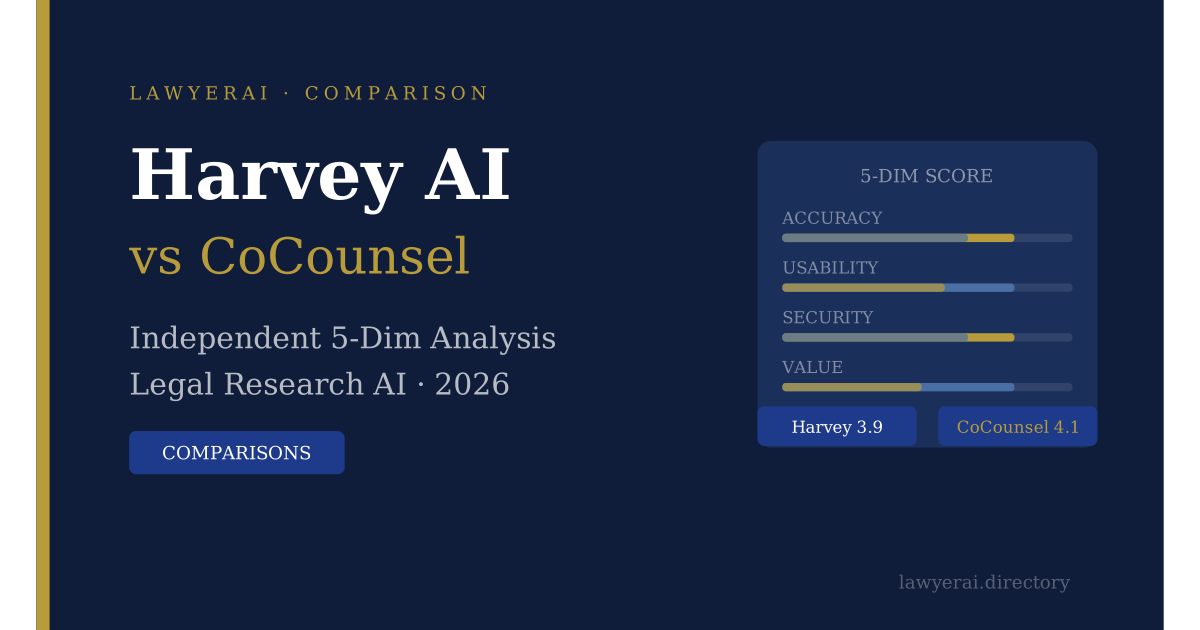
| Dimension | Harvey AI | CoCounsel |
|---|---|---|
| Accuracy | 4.5 | 4.0 |
| Speed | 4.0 | 4.5 |
| Usability | 3.5 | 4.5 |
| Value | 3.0 | 3.5 |
| Security | 4.5 | 4.0 |
| Overall | 3.9 | 4.1 |
The short version: Harvey leads on Accuracy and Security, and is the tool of choice for complex, high-stakes research at large firms. CoCounsel leads on Usability and Speed, and is the better fit for teams that want a research assistant integrated with existing Westlaw workflows.
How They're Built: The Architecture Difference
Harvey AI is built on a custom-trained large language model designed specifically for legal work. Harvey's models are trained on legal documents, case law, and professional standards. The platform does not rely on a third-party legal database as its primary source.
CoCounsel is built on top of Thomson Reuters' Westlaw and Practical Law content databases. The AI adds a conversational research layer on top of the world's largest continuously updated legal database.
This architectural difference has concrete implications:
- Harvey's strength is open-ended legal reasoning and document analysis on complex, multi-part research questions.
- CoCounsel's strength is comprehensive primary law coverage. When the research question requires Shepardizing or knowing a circuit split, CoCounsel's Westlaw foundation provides confidence that Harvey's model-based approach cannot fully replicate.
Accuracy: Harvey Leads for Complex Research
Harvey AI (Accuracy: 4.5) performs strongly on complex research questions that require multi-step legal reasoning. User reports from Am Law 100 firms consistently cite Harvey's accuracy on hard questions as a differentiator. The caveat: on questions at the frontier of the law — novel regulatory interpretations, emerging case law — verification remains essential.
CoCounsel (Accuracy: 4.0) excels on questions with clear answers in Westlaw's database. Its Shepard's integration means CoCounsel automatically flags cases that may no longer be good law — a critical safeguard for citation-heavy work product.
Winner for complex, multi-source research: Harvey AI. Winner for primary law research with citation validation: CoCounsel.
Speed: CoCounsel Leads for Research Workflows
Harvey AI (Speed: 4.0) processes complex research questions at high speed, but the platform's strength is thoroughness over raw speed. Deep Research builds a multi-step research plan and delivers a structured report — more comprehensive but takes longer.
CoCounsel (Speed: 4.5) earns its speed score from workflow integration. The Agent feature accepts a research goal, determines which skills to apply, and executes them in sequence. For attorneys who live in Westlaw, CoCounsel eliminates the context-switching cost of a separate AI tool.
Winner: CoCounsel.
Usability: CoCounsel Leads Significantly
Harvey AI (Usability: 3.5) is a capable platform with a steeper learning curve. Getting full value from Harvey requires meaningful configuration and training. For large firms with dedicated legal technology teams, this is manageable.
CoCounsel (Usability: 4.5) is designed for integration into existing Westlaw workflows. If your firm already pays for Westlaw, adding CoCounsel means adding an AI layer to tools your attorneys already use daily.
Winner: CoCounsel, clearly.
Value: Neither Tool Is Cheap
Harvey AI (Value: 3.0) is priced at the enterprise end of the market. Reported pricing for small teams starts at $5,000–10,000/year per user. For large firms with complex research workloads, the value calculus is positive.
CoCounsel (Value: 3.5) is typically offered as an add-on to existing Westlaw subscriptions. For firms already paying for Westlaw Precision, adding CoCounsel's AI layer represents a more incremental cost increase.
Winner: CoCounsel for existing Westlaw subscribers. Harvey for firms evaluating research platforms from scratch.
Security: Harvey Leads
Harvey AI (Security: 4.5) has the most comprehensive enterprise security documentation in the legal AI category. SOC 2 Type II, explicit no-training commitments, and enterprise data processing agreements are all documented.
CoCounsel (Security: 4.0) benefits from Thomson Reuters' enterprise security infrastructure. SOC 2 compliance and data handling policies are documented.
Winner: Harvey AI by a narrow margin on security documentation depth.
Who Should Choose Harvey AI?
Harvey is the right choice when:
- Your research work is complex and multi-source — M&A due diligence, multi-jurisdictional regulatory analysis
- You are a large firm or enterprise legal department with legal ops support
- Security requirements are the most stringent in the category
- You need document analysis capabilities at scale
For Harvey's full profile, see our Harvey AI review. For a comparison with another enterprise research tool, see Harvey AI vs. Paxton AI.
Who Should Choose CoCounsel?
CoCounsel is the right choice when:
- Your firm already subscribes to Westlaw and wants to add AI capabilities
- You need strong primary law coverage with Shepardizing and citation validation
- Research turnaround time and attorney adoption speed are priorities
For CoCounsel's full profile, see our CoCounsel review. For a comparison within the Thomson Reuters ecosystem, see CoCounsel vs. Westlaw Precision AI.
The Verdict
For large firms doing complex, multi-source research with demanding security requirements: Harvey AI.
For firms already on Westlaw who want an AI layer with strong primary law coverage and faster adoption: CoCounsel.
For solo practitioners and small firms: neither tool's pricing is designed for you. Consider Paxton AI as a more accessible alternative with transparent per-user pricing.
FAQ
Q: Can you use Harvey AI and CoCounsel together?
Yes. Some large firms use Harvey for complex document analysis and CoCounsel for primary law research and Shepardizing. The tools are complementary for teams that can justify both subscriptions.
Q: Which tool has a lower hallucination rate?
Both tools have implemented hallucination mitigation strategies. Neither publishes an independent peer-reviewed benchmark. For any legal research AI, always verify citations before including them in court filings.
Q: Do I need a Westlaw subscription to use CoCounsel?
CoCounsel is most valuable when paired with a Westlaw subscription. Thomson Reuters offers bundled pricing that includes both.
Q: Are there alternatives to Harvey and CoCounsel for legal research?
Yes. Paxton AI is the most accessible alternative for small firms. Lexis+ AI provides the LexisNexis equivalent to CoCounsel. See our Legal Research category for all reviewed options.
Q: How often do Harvey AI and CoCounsel update their capabilities?
Both platforms have released significant capability updates in 2026. For current feature sets, check each platform's product changelog directly.
Scores reflect editorial assessment based on public documentation and user reports as of May 2026. Hands-on review pending for select tools. Neither Harvey AI nor Thomson Reuters paid for placement. See our Editorial Independence policy.