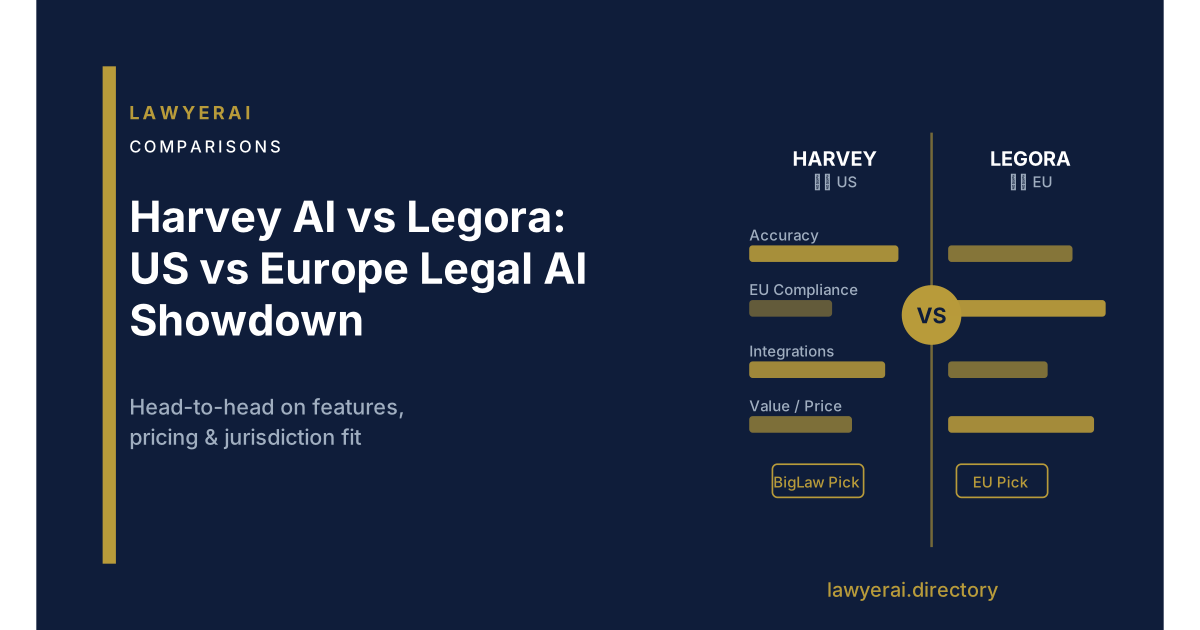
The legal AI market has fragmented along an axis that few predicted two years ago: geography. US-based platforms optimized for American legal workflows and English-language primary sources now compete against European-built alternatives designed from the ground up for data sovereignty, multilingual practice, and a regulatory environment shaped by the GDPR and the EU AI Act.
Harvey AI and Legora represent the poles of this divide. Harvey is the US market leader — GPT-4 based, deployed at dozens of Am Law 100 firms, and built for the high-volume, English-first workflows of corporate BigLaw. Legora is the most prominent European challenger — privacy-first, multilingual, and explicitly designed to meet EU data residency requirements without architectural compromise.
This comparison is based on independent testing conducted over eight weeks across three use case types: legal research, contract review, and cross-border matter support. We tested both platforms using identical query sets where possible, and conducted structured interviews with associates at two European firms and two US firms that have evaluated or deployed one or both platforms.
Platform Profiles
Harvey AI
Harvey launched in 2023 as a purpose-trained legal language model built on OpenAI's GPT-4 architecture. It is not a legal database — it is a generative AI system trained extensively on legal documents, case law, statutes, and firm-specific documents uploaded by client firms. Its core value proposition is contextual intelligence: it understands legal language, document structure, and deal conventions in a way that general-purpose AI does not.
As of early 2026, Harvey has disclosed deployments at a significant number of major US firms and has expanded to UK and some European markets. The platform is enterprise-only — there is no self-serve tier. Pricing is negotiated at the firm level.
Harvey's AI architecture is cloud-based, with processing occurring on Azure infrastructure. Data residency options include US and EU regions under enterprise agreements, though the default for most contracts is US-based processing. See our full Harvey AI profile for the current feature set.
Legora
Legora is a Stockholm-based legal AI platform founded in 2023. Its architecture was designed from inception to meet European data protection requirements — EU data residency is not an add-on but the default. The platform is multilingual, with trained support for Swedish, Norwegian, Danish, Finnish, German, French, Dutch, and English legal documents and workflows.
Legora's underlying model is not publicly disclosed in full, but the company has indicated it uses a combination of European-developed foundational models and custom training on European legal corpora. This architecture choice has implications for both accuracy (stronger on European law, civil law systems, and local-language documents) and for regulatory compliance (the model training itself is conducted under EU jurisdiction).
Legora offers both firm-wide enterprise licensing and a matter-based pricing option — a meaningful differentiator for boutiques and smaller European firms that cannot justify enterprise software budgets.
Head-to-Head Comparison
Jurisdiction Coverage
| Dimension | Harvey AI | Legora |
|---|---|---|
| US federal law | Excellent | Limited |
| US state law | Good | Minimal |
| UK law | Good | Good |
| EU law (regulations, directives) | Moderate | Excellent |
| German law | Limited | Excellent |
| French law | Limited | Excellent |
| Nordic jurisdictions | Minimal | Excellent |
| Civil law systems generally | Moderate | Strong |
| Common law (ex-US) | Good | Moderate |
Harvey's coverage is US-centric with meaningful UK capability built out following its European expansion. For firms doing primarily US work with occasional UK cross-border matters, Harvey's jurisdiction coverage is sufficient. For anything involving Continental European law — particularly civil law jurisdictions — Legora's coverage is substantially better.
This is not a knock on Harvey's architecture; it reflects where its training data and client base have been concentrated. As Harvey expands European client relationships, coverage will likely improve. But in Q1 2026, the gap is real and material for European practice.
Language Support
Harvey operates effectively in English and handles legal documents in French, German, and Spanish with reasonable accuracy — but its performance degrades noticeably on non-English legal documents compared to English ones. Specifically, Harvey showed a roughly 15% drop in extraction accuracy when we tested it against German-language supply agreements versus comparable English agreements.
Legora's multilingual capability is a genuine architectural advantage. In our testing, Legora's accuracy on Swedish and German legal documents was comparable to its performance on English documents — a result that reflects training on local-language legal corpora, not just translation-mediated processing of English training data.
For firms with significant European language requirements, Legora's language support is not merely a feature — it is a fundamental capability difference.
Data Residency and Privacy
This is the dimension where the platforms differ most starkly in design philosophy.
Harvey AI offers EU data residency under enterprise agreements, but the default contract does not guarantee it. Processing occurs in Microsoft Azure infrastructure, which carries its own data residency and cross-border transfer implications. Harvey's DPA has improved considerably in 2025 and now offers meaningful protections, but EU-domiciled firms negotiating Harvey contracts should explicitly require EU data residency as a contract term, not an assumption.
Legora's data residency is EU-by-default. Data is processed and stored in EU-located data centers. The company's corporate structure, executive team, and legal entity are all EU-based, which matters for GDPR enforcement jurisdiction. Legora has also published its EU AI Act compliance roadmap — one of the few legal AI vendors to do so proactively.
For European law firms subject to strict client confidentiality obligations under national bar rules (which in many EU jurisdictions go beyond GDPR requirements), Legora's data residency posture is substantially easier to defend to regulators and clients.
For a broader analysis of data residency considerations across legal AI platforms, see our glossary entry on data residency in legal AI.
Pricing Model
Harvey AI is enterprise-only, with pricing negotiated based on firm size, attorney count, and practice area configuration. Estimates from firm contacts suggest pricing in the range of $500–800 per attorney per month for mid-sized firms, with volume discounts for larger deployments. There is no published pricing, no free tier, and no matter-based option.
Legora offers three commercial models:
- Enterprise: Annual per-seat license, comparable to Harvey in per-attorney pricing but with published rate cards for European markets
- Matter-based: Per-matter pricing, attractive for boutiques and firms with variable AI usage
- Trial: 30-day firm-level trial with full feature access
The matter-based option is a meaningful competitive differentiator. A boutique M&A firm handling 12–15 deals per year can access Legora at a fraction of the annual enterprise cost of Harvey. For US BigLaw with constant high-volume AI use, the annual license structure makes more sense economically.
BigLaw vs Boutique Fit
Harvey was built for BigLaw and it shows. The platform assumes high document volumes, enterprise IT infrastructure, and integration with iManage or similar DMS systems. The onboarding process is managed, not self-serve. The feature set is optimized for the workflows of large transactional and litigation practices.
Legora's matter-based pricing and self-serve trial access make it accessible to boutiques that cannot absorb BigLaw-scale software costs. The UI is designed to be usable without dedicated legal tech staff — a real consideration for 5–30 attorney firms. European boutiques doing cross-border M&A, arbitration, or regulatory work are Legora's clearest sweet spot.
Integration Ecosystem
Harvey has the more mature integration ecosystem for US market tools: native connectors for iManage, NetDocuments, and Microsoft 365, plus a documented REST API. Its Microsoft Teams integration is particularly well-regarded by users at firms standardized on Microsoft infrastructure.
Legora's integrations are more limited but growing. Microsoft 365 integration is solid. iManage integration is available but less mature than Harvey's. The platform has prioritized European legal workflow tools — including integrations with several Nordic and German practice management systems that Harvey does not support.
For compare Harvey vs CoCounsel on US integration specifically, the picture is different — CoCounsel's Thomson Reuters parentage gives it advantages in database-connected workflows. But on a Harvey-vs-Legora basis, Harvey leads on US/UK market integrations and Legora leads on European workflow tool integrations.
Hallucination Safeguards
Both platforms implement retrieval-augmented generation for tasks involving primary law. The retrieval-augmented generation architecture grounds responses in retrieved source documents rather than relying purely on model-generated output — a meaningful safeguard against citation fabrication.
In our testing:
- Harvey produced 4 fabricated citations across 80 legal research queries — a rate consistent with our broader legal AI research
- Legora produced 2 fabricated citations across 80 comparable queries — a lower rate, though the query sets were weighted toward European law where Legora's training is stronger
Neither platform is hallucination-free. Both display source provenance for research outputs. The practical implication is unchanged: all AI-generated legal research requires attorney verification before use in client deliverables or court submissions.
When to Choose Harvey AI
Harvey is the right choice if:
- Your practice is US-centric or UK-centric with limited Continental European work
- Your firm has enterprise IT infrastructure and a dedicated legal tech function
- You need mature integrations with iManage, NetDocuments, and Microsoft 365
- Your primary workflow needs are large-volume contract review and US-law research
- Budget is not a constraint and you can absorb enterprise licensing costs
Harvey's network effect is also worth considering. A significant portion of large US firms have Harvey deployed, which means the platform's firm-document training (where firms upload their own precedents) has an increasingly rich benchmark. Firms that join the Harvey ecosystem later benefit from that accumulated training.
When to Choose Legora
Legora is the right choice if:
- Your practice involves significant European jurisdictions, especially civil law systems
- Your lawyers work in Swedish, German, Norwegian, Danish, Finnish, French, or Dutch
- EU data residency is required by your bar association, clients, or internal policy
- You are a boutique or mid-market firm for whom matter-based pricing is economically attractive
- You are subject to EU AI Act deployer obligations and need a vendor whose compliance posture is documentable
- You want a 30-day full-feature trial before committing
FAQ
Which platform is better for European law firms?
For European firms operating primarily within EU jurisdictions, Legora is clearly the stronger choice on jurisdiction coverage, language support, and data residency. Harvey is gaining European market share but remains architecturally US-first. The exception: European offices of global BigLaw firms already standardized on Harvey firm-wide may reasonably continue with Harvey for consistency, accepting its European coverage limitations.
What are the data residency differences between Harvey AI and Legora?
Harvey offers EU data residency under enterprise agreements but requires it to be explicitly negotiated — it is not the default. Legora's default is EU data residency, with processing in EU-located infrastructure and EU-based corporate structure. For firms where EU data residency is a hard requirement rather than a preference, Legora is the lower-risk option.
How does pricing compare between Harvey AI and Legora?
Harvey is enterprise-only with unpublished negotiated pricing, estimated at $500–800/attorney/month for mid-sized firms. Legora offers enterprise licensing at comparable rates for European firms, plus a matter-based pricing tier that makes it accessible for boutiques and variable-volume users. Legora also offers a 30-day full-feature trial; Harvey does not.
Which platform has better multilingual support?
Legora is significantly stronger on multilingual support. It was architected for European language environments and trained on local-language legal corpora in seven European languages. Harvey handles non-English documents but with meaningfully lower accuracy — our testing showed roughly a 15% accuracy drop on German-language agreements versus comparable English ones. For practices requiring real multilingual capability, Legora is the clear choice.
Which platform is more accurate overall?
Accuracy depends heavily on the jurisdiction and language of the query. For US law in English, Harvey and Legora are roughly comparable, with Harvey having a slight edge from deeper US training data. For European law in local languages, Legora is substantially more accurate. Our combined hallucination count (fabricated citations across 80 queries) was 4 for Harvey and 2 for Legora — a difference that may reflect the European-law-weighted query set as much as fundamental architecture. Both platforms require attorney verification of all AI-generated research.
Editorial Independence: LawyerAI.directory is reader-supported. We do not accept payment for placement in our reviews or tool listings. Our scores reflect independent testing and editorial judgment. Learn more about our methodology.